
Tuesday, 22 January 2013

Friday, 4 January 2013
Treatment
A desk in a detective’s office (props
around the room to indicate it’s a detectives office such as lots of paperwork,
police badge etc.) with a silhouette of a man dressed in full black, with a
long black coat, and black hat shadowing his face, tapping his nail on the
desk. His phone and hand is lit up by a lamp on the table. He receives a message
causing his phone to light up. He takes a deep breath and looks at the phone,
cuts to over the shoulder shot of the phone. Message from an unknown number,
the message reads “Hollywood car park, 42 Angel Street, Norwich, 9th
floor J”
He has one leather glove on as he opens a draw, you see him tugging on
something but never get to see what. He then puts the item in his pocket and as
he walks out of the room he puts on the other leather glove. During all of
this, you never get to see the man’s face.
Cuts
to a woman with a suitcase walking towards the car park, the shot comes from
the neck down so we never see her face. Following the 180 degree rule. She is dressed in a bright red dress, with
black heels. All you can hear is her footsteps as she walks along the
pathement. You then see that the lift is out of order, and she makes her way up
the staircase, using a low angled shot, level with the staircase. It then cuts
to shot of a sign that says “9th floor”, with a graffiti “J” on it, and
the camera slowly moves down, and as it sinks you see the women go up the final
step, and the camera then reaches the bottom step and you then hear a scream,
followed by a choking sound.
Our
opening to our thriller takes inspiration from such thrillers as, “The Third
Man”. The way you never clearly see our character has been taken from this
film, in the way that it hides one of the main characters, “Harry Lime”. We
have decided to take this idea, and use it as our own as it creates tension and
enigma in the plot. As for the way our characters look, again this is taken
from “The Third Man”, but not only that, also “LA Confidential”. Both films use
classic film noir costumes for male and female, and that is approach we would
like to take.
Thursday, 29 November 2012
Sunday, 25 November 2012
If Thrillers were a tube map...

Wednesday, 14 November 2012
LA Noire: How does it use features of film noir?


In this image we can see the use of chiaroscuro lighting familair to the film noir genre. A strong shadow has been created on the dimly lit and melancholy scene similair to that of scenes in Double Indemnity, Casino Royale and The Third Man. This increases the mystery and tension and sets the mysterious atmosphere present in many film noir movies.
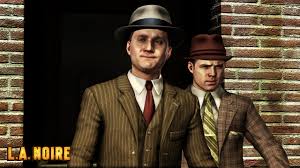
The outfits featured are also a typical feature of film noir. Suits and hats add to the detective style story lines and add to the enigma of the game. Suits give the men a business like impression and suggests they are of an upper class and have important duties.

Guns are another significant prop commonly used in film noir. A gun represents the corruption, aggression and violence present in film noir. It builds up the tension as it is inevitable that someone will die. The lighting in this image shows the moral ambiguity that is seen often in film noir movies such as casino royale. It suggests to the audience that the hero is not everything he seems, half bad and half good, represented by the dark shadow across his face.
Many phrases appeared within the opening such as "City of undercurrents where everything is not what it seems". This iniciates the feeling of deception and underlying secrets, typical to film noir movies. "Chasing shadows" and "Who do you trust" adds to the suspence and tension felt by the audience. It draws them into the chaotic and deceptive life lead by the characters in LA Noire.
The use of a torch is very similair to The Third Man. It acts as a high intensity spot light which reveals small amount of the surroundings at a time. This heightens the tension and adrenalin felt by the audience as though a significant discovery will be revealed at any point. This further draws people in to the story, which is a highly recognisable trait of film noir.
An effective camera technique used in LA Noire is that the camera always moves. It gives a better flow and moves the story at a steady pace, keeping the audience involved and alert. There are also the typical film noir style camera shots such as the rule of thirds, over the shoulder shots and obscured shots to suggest the audience is spying.
Monday, 12 November 2012
Discovery of Harry Lime - The Third Man


In this shot we see the revealing of Harry (Orson Welles) who was believed to be dead. The high intensity spot light and close up on Harry smiling is supposedly caused by a woman opening her window above where he is standing revealing his face. The way his face is lit up is quite ghostly which adds to the enigma of the film, as he was supposedly dead! The light disappears and Harry disappears just as quickly when the shutters above him are closed suddenly.

Subscribe to:
Posts (Atom)